Introduction
Have you ever asked yourself what is blockchain? This guide gives you a clear answer. Blockchain is the technology behind Bitcoin, Ethereum and thousands of other digital assets. Banks, hospitals and shipping companies also use it to keep records safe. You will learn how blockchain works, its main types, its benefits and its risks.
What Is Blockchain?
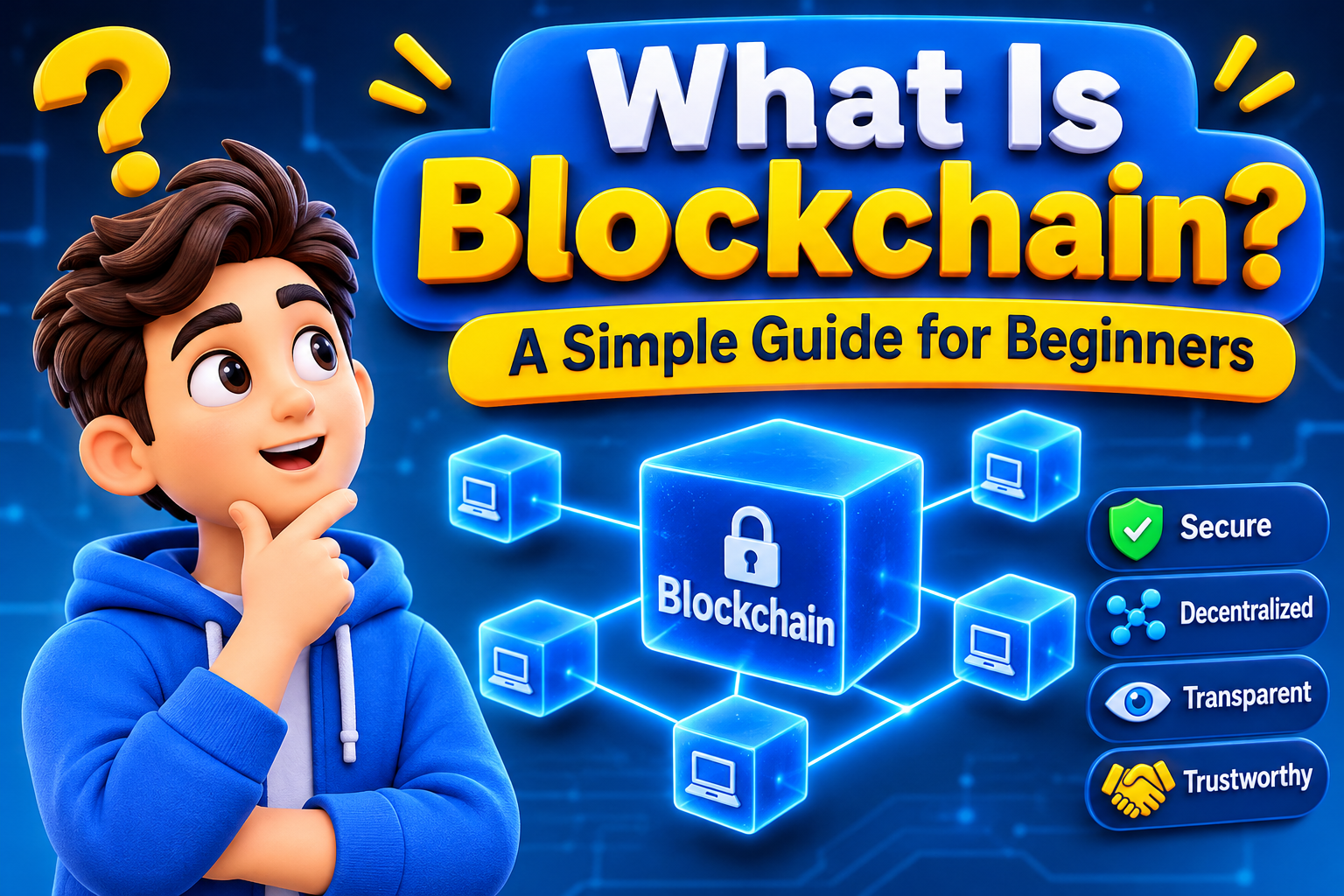
Blockchain is a shared digital record book that stores information on many computers at once. A bank keeps data on its own central server. A blockchain spreads the same copy across a whole network instead. Nobody owns it alone, and nobody can secretly change it.
Picture a Google Sheet that thousands of people can see, where no one can quietly edit or delete old entries. That is the basic idea.
How Does Blockchain Work?
Step 1: Someone Starts a Transaction
A user sends crypto, signs a contract or records data. The network receives that request.
Step 2: The Network Checks It
Computers on the network, called nodes, confirm that the transaction is valid. Strict rules guide this check.
Step 3: The Transaction Joins a Block
After the check, the transaction joins others inside a block. Each block holds data, a timestamp and a unique code called a hash.
Step 4: The Block Joins the Chain
Each new block carries the hash of the block before it, which links every block into a chain. If someone changes an old block, its hash changes too, and the whole network sees the difference. This is why blockchain records are very hard to fake.
Key Features of Blockchain
- Decentralization: No single company or government runs the network.
- Transparency: Anyone can view the records on a public blockchain.
- Permanent records: Once the network saves data, nobody can easily change it.
- Security: Cryptography protects every transaction.
- Consensus: Nodes must agree before the network adds new data.
Consensus Mechanisms Explained
A consensus mechanism is the method nodes use to agree on what is true.
Proof of Work (PoW)
Miners solve complex puzzles to add new blocks. Bitcoin uses this method. It offers strong security, but it burns a lot of energy.
Proof of Stake (PoS)
Validators lock up their own coins as a promise to play fair. Cheaters lose their stake. Ethereum uses this method, which needs far less energy than PoW.
Types of Blockchain
1. Public Blockchain
Anyone can join, read and verify transactions. Bitcoin and Ethereum are public blockchains.
2. Private Blockchain
One organization controls access. Companies use this type for internal records.
3. Consortium Blockchain
A group of organizations shares control. Banks and supply chain partners often choose this type.
4. Hybrid Blockchain
A hybrid mixes public and private features. Companies can keep some data private and share the rest.
Real-World Uses of Blockchain
- Cryptocurrency: Blockchain powers digital money and fast global payments.
- Smart contracts: These programs run on their own when set conditions match, so users do not need middlemen.
- Supply chain tracking: Companies follow products from factory to shop and spot fake goods.
- Healthcare: Hospitals store patient records securely and share them with permission.
- Finance: Banks settle payments faster and cut costs.
- Digital identity: People prove who they are without sharing extra personal data.
- NFTs and gaming: Blockchain shows who owns a digital item.
Benefits of Blockchain
- Better security: Hackers struggle to change data that sits on thousands of computers.
- Lower costs: Fewer middlemen mean lower fees.
- Faster settlements: Payments can finish in minutes instead of days.
- More trust: Everyone sees the same record, so fewer disputes happen.
Limitations and Risks
Blockchain is powerful, but it has weaknesses:
- Scalability: Some networks process only a few transactions per second.
- Energy use: Proof of Work chains consume a lot of electricity.
- Regulation: Laws differ across countries and keep changing.
- User mistakes: A lost private key means lost access to your funds.
- Weak apps around the chain: Exchanges, wallets and smart contracts can suffer hacks, even when the blockchain itself stays secure.
Blockchain vs. Traditional Database
| Feature | Blockchain | Traditional Database |
|---|---|---|
| Control | Decentralized | Centralized |
| Editing data | Very difficult | Easy for the owner |
| Transparency | High | Limited |
| Speed | Often slower | Usually faster |
| Trust | Network builds trust | You trust one owner |
Frequently Asked Questions (FAQs)
What is blockchain in simple words?
Blockchain is a digital record book that many computers share. Once the network adds data, people cannot easily change it.
Is blockchain the same as Bitcoin?
No. Bitcoin is a cryptocurrency that runs on blockchain, and many other projects use the same technology.
Is blockchain safe?
The core technology is very secure. Scams, weak apps and lost keys can still cause losses, though.
Who invented blockchain?
A person or group using the name Satoshi Nakamoto introduced the first blockchain with Bitcoin in 2008 and 2009.
Can blockchain be hacked?
Hacking a large public blockchain is extremely hard. Attackers usually target exchanges, wallets or poorly written smart contracts instead.
What industries use blockchain?
Finance, healthcare, logistics, gaming, real estate and government services all use it.
Conclusion
So, what is blockchain? You can think of it as a secure, shared digital ledger that records data across many computers without a central owner. Crypto depends on it, payments move faster because of it, and many industries now trust it. Speed and regulation remain real limits, however. Learn the basics, follow trusted sources and keep exploring this fast-growing technology.
Disclaimer: This article is for educational purposes only and is not financial advice.